Do solar panels work in Welsh weather?
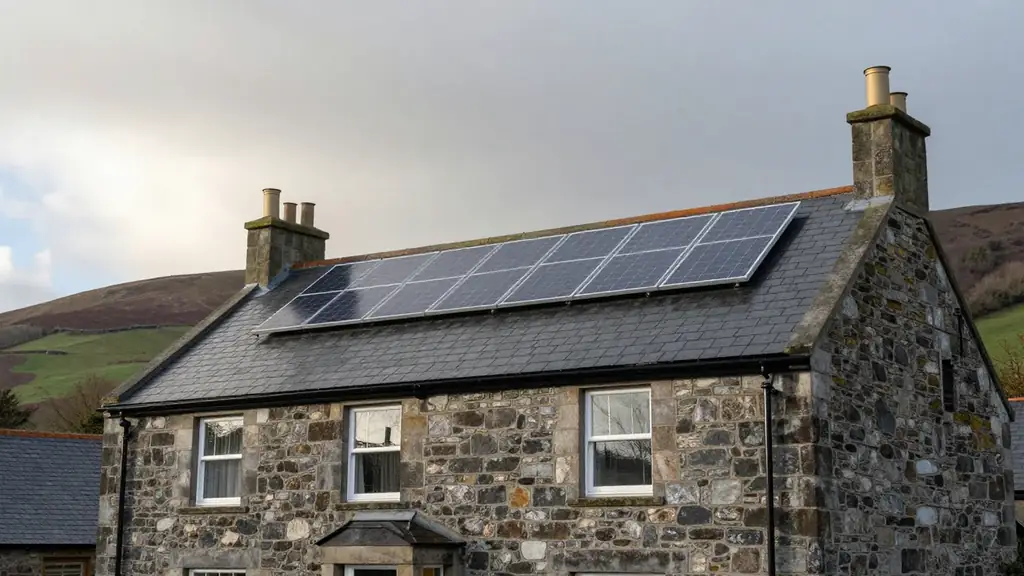
Yes, solar panels work well in Wales. A south-facing roof tilted at 35 degrees makes about 820 to 1,060 kWh a year for each kWp of panels. That is enough to cut a household electricity bill noticeably, even in a wet climate. Weather changes the output from day to day, but the yearly total is steady.
Why Welsh weather is not a barrier
Panels turn daylight into power, not just direct sun. On a cloudy day they still make electricity, although less than on a clear one. Over a full year, the bright months make up for the dull ones.
The European Commission’s PVGIS tool models this using years of satellite radiation data. Its Welsh figures therefore reflect typical local weather, including cloud. We used it for every number in this guide. Our guide to solar yield in Wales explains how to read these figures for your own home.
The Energy Saving Trust backs this up with payback estimates. For Aberystwyth, it suggests around 9 to 10 years, depending on when someone is home. Aberystwyth is the only Welsh point in that estimate, so do not stretch it to other towns.
How much output to expect across Wales
Output varies by place, and the gap can be large. Here are PVGIS figures for a south-facing roof at 35 degrees, per kWp each year. Holyhead is at about 1,056 and Cardiff at about 1,042. Llanelli is near 1,036 and Aberystwyth near 954.
Llandudno is near 947, and Bangor comes in lower at about 817. Bangor and Ebbw Vale score lower because the model includes shading from surrounding hills. A 4 kWp south-facing system would therefore make about 3,300 to 4,200 kWh a year across Wales.
Do not use the old rule of 750 kWh per kWp. It comes from a 2016 Welsh Government report, and current figures for Wales are higher. If an installer still quotes it, ask why.
Coastal sites and sea air
Many Welsh homes sit close to the sea, and that can affect how you choose a mounting system. Holyhead on Anglesey has the highest figure in the list above. For a closer look at the island, see our page on solar installers around Holyhead.
Salt and wind also matter, although we do not have Welsh data on how they wear panels. Ask your installer how the mounting system copes with exposure. A written answer is better than a quick reassurance. Our guide to how long solar panels last covers lifespan and warranties.
Rain, dirt and cleaning
Rain usually helps rather than harms. It washes dust and grime off panels that tilt at 15 degrees or more. For that reason, many roofs need little or no cleaning.
Shallower roofs and dusty or ground-level sites may need an occasional clean. Trees are a bigger concern, because overhanging branches cast shade and drop leaves. Keep nearby trees trimmed, and ask your installer for written maintenance advice. MCS rules require the installer to leave handover documents, and those should include fault signs to watch for.
Hills, shade and roof direction
Shade matters more than cloud. A chimney, a tall tree or a neighbouring building can cut output on part of a roof. MCS requires a shade factor in the performance estimate, so you can see the effect before you buy. Power optimisers or microinverters can limit the loss, though they add nothing on an unshaded roof.
Roof direction matters too. East or west faces make about 15 to 20% less than south. South-east or south-west roofs make about 95% of south output. North-facing roofs are not recommended, with only 53 to 59% of south output in the PVGIS runs. Read more in our post on east-west and north-facing roofs.
Slope costs less than most people expect. In Cardiff, a 15 degree roof makes 976 kWh per kWp and a 60 degree roof 993, against 1,042 at 35 degrees. Therefore a shallow Welsh roof is rarely a reason to say no.
Winter in Wales
Winter output is low, because days are short and the sun sits low. Summer makes up most of the yearly total. That is why a battery or a smart tariff can help you use power at other times of day. We weigh this up in our battery guide, and our solar battery storage page lists the options.
What this means for your roof
Start with the roof, not the weather. A south, south-east or south-west roof with little shade is a good candidate almost anywhere in Wales. Check the size of the roof too, since a larger array makes more power. Our post on how many panels you need helps you size it.
Roof material counts as well. Many older Welsh homes have slate, which needs careful fixings, so see our post on fitting panels to slate roofs. If you live in a coastal town, you can also compare installers serving the Llandudno area. In mid Wales, look at firms working near Aberystwyth.
What the weather means for your bill
The Welsh Government says households with solar save over £500 a year on average. The UK Government’s Warm Homes Plan gives a lower example of about £450 a year. Both are averages across real homes. Your own saving depends mostly on how much of the power you use yourself.
Getting a realistic estimate
Ask every installer for an MCS performance estimate. The standard requires a set format with orientation, tilt and shade factor. It also warns that real output can differ if the assessor looked at the roof remotely. A site visit gives a better estimate than a desktop one.
We are an independent Welsh solar guide, not an installer. Our form passes your enquiry to MCS-certified installers, and you can compare their estimates side by side. Start with our solar panel installation page for an overview.
Frequently asked questions
Do solar panels work on cloudy or rainy days?
Do I need to clean my panels in the rain?
Which parts of Wales make the most solar power?
How do I know what my roof will make?
Ready to compare installer quotes?
Our quote service is free and opt-in. You fill in a short form, and the operator looks for MCS-certified installers near your postcode. Nothing reaches an installer until you ask, so you stay in control.