MCS certification explained: why it matters for your quote
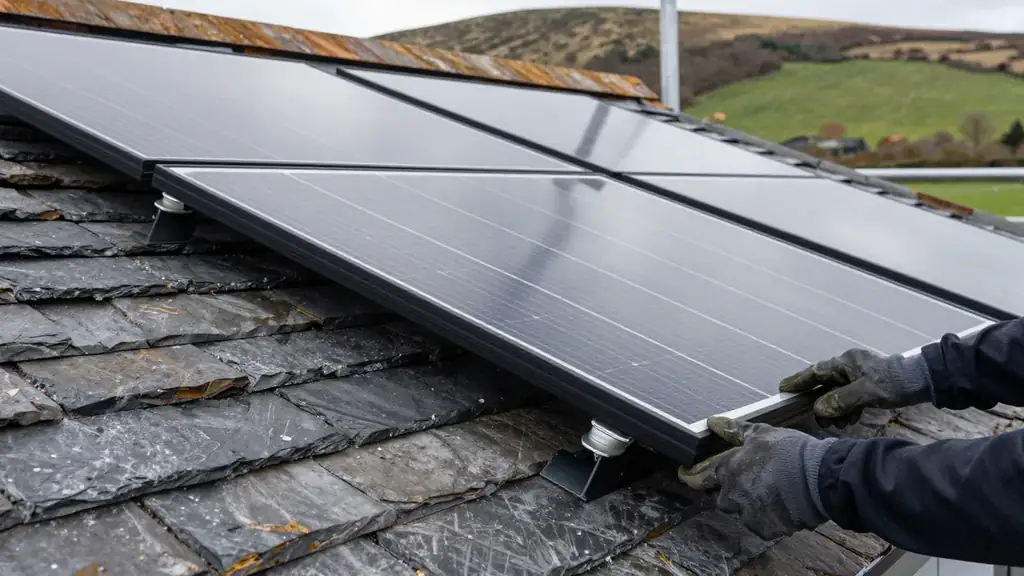
You will see “MCS certified” on almost every solar quote. However, it is more than a badge, because it affects your money, your paperwork and your protection. This post explains what it means and what to check.
MCS is the Microgeneration Certification Scheme. It is the UK quality mark for small renewable systems such as solar panels, heat pumps and batteries. It covers the installer, the products and the finished job.
Why MCS affects your payments
The Smart Export Guarantee pays you for power you send to the grid. For solar of 50 kW or less, Ofgem says you must show that the system and the installer are certified. That means an MCS certificate, or a scheme your supplier accepts in its place. As a result, you may not get paid for exports without one.
The same logic applies to other schemes. For example, Boiler Upgrade Scheme grants for heat pumps need an MCS-certified installer. Our post on whether you can get free solar panels in Wales explains which schemes help with costs.
What the MCS standard asks of an installer
The solar standard is MIS 3002. Issue 6.0 carries the date 18 March 2026 and covers systems up to 50 kWp. MCS contractors have had to follow it since 18 June 2026.
The standard asks for a written performance estimate in a set format. The estimate states orientation, inclination and a shade factor. However, actual performance can differ if the installer assessed the roof remotely, and the estimate says so.
It also requires handover documents and gives a maintenance schedule. As a result, you can hold an installer to a clear list of paperwork. Our post on solar panel maintenance and cleaning covers what the schedule asks of you.
Batteries have their own standard
MCS also has a battery standard, MIS 3012. It covers batteries up to 50 kW in permanent buildings. In particular, if an installer quotes for battery self-consumption but lacks that certification, MIS 3002 says the quote must make this clear.
Our post on whether a solar battery is worth it covers cost, while MCS only tells you who fits it and to what standard. Look for that line if your quote includes storage.
What MCS does not do
MCS does not set your price. It does not decide whether your roof suits solar, and it does not replace a written contract. Therefore you still need to compare quotes and read the small print. For example, two MCS installers can quote very different prices for the same roof. Ask each one to explain the gap in writing, and weigh the design and the protection as well as the headline cost.
Consumer codes are no longer a condition
This area changed recently. Although MCS no longer demands a consumer code, installers can still choose to join one. Installers move to the new scheme in phases, and all must be on it by 31 March 2027.
The Renewable Energy Consumer Code, known as RECC, published version 9 on 1 July 2026. Similarly, HIES is the other code in the sector. It says its installers follow a code approved by the Chartered Trading Standards Institute.
The RECC code binds its members to several protections:
- written contracts
- a cancellation period of at least 14 days, with a refund within 14 days
- deposits that are a reasonable share of the cost, never above 25%
- deposit plus further advance payments never above 60%
- insured deposits, so another member can finish the work if the installer fails
- a free workmanship guarantee of at least two years, insurance-backed and transferable to a new owner
So ask each installer whether they belong to a consumer code. Ask how they protect your deposit and their workmanship too, because written answers protect you later.
The new financial protection requirement
The redeveloped scheme also requires each installer to buy an MCS-approved financial protection product for the customer. Specifically, it gives at least six years of cover from installation. It protects you if the installer goes bust, retires or refuses to fix a fault. The claims excess is capped at £250.
MCS says installers “will need to” buy it, although products are available now. Ask to see the policy documents and the start date of cover. Since the cover runs from installation, the date matters.
Building Regulations are separate
MCS does not replace the Building Regulations. In Wales, an installer registered with a competent person scheme can self-certify compliance and should notify the council. Schemes authorised for renewable technologies include APHC, BESCA, Certsure, HETAS, NAPIT, OFTEC and Stroma. Therefore, ask which scheme your installer uses and when you will get the certificate.
The network operator must also hear about your system. Our post on G98 and G99 and the network operator explains the process. Your installer normally handles it, although you should confirm that in writing.
A checklist for Welsh homeowners
Before you accept a quote, confirm these points:
- the installer is MCS certified, and you hold the certificate number
- the quote includes a written design with orientation, inclination and shade
- the quote names the equipment and states what it excludes
- you know whether the installer belongs to RECC, HIES or another code
- you have seen the financial protection and deposit protection terms
Also watch the sales process, because the Competition and Markets Authority publishes guidance on unfair commercial practices. It applies to sales and marketing. Walk away from any pressure to sign on the day. Our post on solar panel costs in Wales gives price ranges you can compare against any offer.
Where this applies in Wales
The MCS rules are the same across the UK, although your network operator is not. National Grid Electricity Distribution serves the south, and SP Energy Networks serves the north through SP Manweb. Ask about the grid approval as well as the MCS certificate.
Local pages cover solar installers around Wrexham, solar panel quotes in Cardiff and solar installers near Bridgend. Each shows the council and the grid operator, since both vary by area.
The Solar Cymru enquiry form passes your details to MCS-certified installers. Use our guide to choosing an installer in Wales to compare what you get back. Start from the page on solar panel installation when you are ready.
Frequently asked questions
What does MCS stand for?
Do I need MCS to get Smart Export Guarantee payments?
Is a consumer code membership still required?
What is the MCS financial protection product?
Ready to compare installer quotes?
Our quote service is free and opt-in. You fill in a short form, and the operator looks for MCS-certified installers near your postcode. Nothing reaches an installer until you ask, so you stay in control.